by Micheal Shackelford

History 223: Modern Europe
| Sarajevo, June 28, 1914
by Micheal Shackelford |
|
Events Leading Up to Murder
Bosnia and Herzegovina were provinces just south of Austria which had,
until 1878, been governed by the Turks. The Treaty of Berlin (1878) settled
the disposition of lands lost by the Turks following their disastrous war
with Russia. Austria was granted the power to administer the two provinces
indefinitely. Bosnia was populated primarily by three groups--Croats (Roman
Catholic), ethnic Serbs (Serb-Orthodox) and Muslims (left from the days
of Turkish rule). There is no ethnic group: Bosnians. Many Bosnian-Serbs
felt a strong nationalistic desire to have their province joined with that
of their Serb brothers across the river in Serbia. Many in Serbia openly
shared that desire.
The Annexation
On October 6, 1908, Austria annexed Bosnia and Herzegovina directly
into the Austro-Hungarian empire. The reasons were complex. Annexation
would remove any hopes Turkey might have for reclaiming the provinces.
Full inclusion into the empire would give Bosnians full rights and privileges.
It may have been an act of will by the Austrians, just to show that they
were still an active, sovereign power. For whatever reason, the annexation
caused quite a stir in Europe. The move was not exactly legal. Russia,
particularly, was upset, even though the Russians had earlier given their
consent to the annexation. After Austria payed Turkey a cash settlement,
most of Europe calmed down. The Serbs, however, did not. They coveted the
provinces for their own Serb empire.
The Black Hand
A secret society called Ujedinjenje ili Smrt, ('Union or Death')
was founded in Belgrade, an outgrowth of an older Serb nationalist group:
Narodna
Odbrana . The Black Hand took over the older group's work of anti-Austrian
propaganda within Serbia, sabotage, espionage and political murders abroad--especially
in provinces Serbia wished to annex. The group included many government
officials, professionals and army officers. When it was learned that the
Heir-Apparent to the Austrian throne, Franz Ferdinand, was scheduled to
visit Sarajevo in June of 1914, the Black Hand decided to assassinate him.
Three young Bosnians were recruited, trained and equipped: Gavrilo Princip,
Nedjelko Cabrinovic and Trifko Grabez.
The Serbian Government
Because of its many government and army members, the Black Hand's activities
were fairly well known to the Serbian government. When Prime Minister Pasic
learned of the assassination plot, he had a difficult problem on his hands.
If he did nothing, and the plot succeeded the Black Hand's involvement
would surely come to light. The tangled connections between the Black Hand
and the Serbian government would put Serbia in a very bad position. It
could even bring on war with Austria. Should he warn the Austrians of the
plot, he would be seen as a traitor by his countrymen. He would also be
admitting to deeper knowledge of anti-Austrian actions in Serbia.
A weak attempt was made to intercept the assassins at the border. When
that failed, Pasic decided that he would try to warn the Austrians in carefully
vague diplomatic ways that would not expose the Black Hand.
The Warning
The Serbian Minister to Vienna, Jovan Jovanovic, was given the task
of warning the Austrians. Because of his extremist, pan-Serb views, Jovanovich
was not well received in Austrian Foreign Ministry offices. He did, however,
get along better with the Minister of Finance, Dr. Leon von Bilinski. On
June 5, Jovanovic told Bilinski, that it might be good and reasonable if
Franz Ferdinand were to not go to Sarajevo. "Some young Serb might put
a live rather than a blank cartridge in his gun and fire it." Bilinski,
unaccustomed to subtle diplomatic innuendo, completely missed the warning.
"Let us hope nothing does happen" he responded good humoredly. Jovanovic
strongly suspected that Bilinski did not understand, but made no further
effort to convey the warning.
Preparations
The three Black Hand trainees secretly made their way back to Sarajevo
roughly a month before Franz Ferdinand. A fourth man, Danilo Ilic, had
joined the group and on his own initiative, recruited three others. Vaso
Cubrilovic and Cvijetko Popovic were 17 year old high school students.
Muhamed Mehmedbasic, a Bosnian muslim, was added to give the group a less
pan-Serb appearance. Four Serbian army pistols and six bombs were were
supplied from Serbian army arsenals.
The Visit
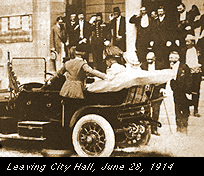 Franz Ferdinand accepted the invitation of Bosnia's governor, General Oskar
Potoirek, to inspect the army manoeuvres being held outside Sarajevo. The
Archduke's role as Inspector General of the Army made the visit logical.
It had also been four years since a prominent Hapsburg had made a goodwill
visit to Bosnia. The visit would also roughly coincide with his 14th wedding
anniversary. While his wife Sophie, not being of royal blood, was not permitted
to ride in the same car as her royal husband back in Vienna, such taboos
did not apply to provincial cities like Sarajevo. During the visit, Sophie
would be able to ride beside her husband--a thoughtful anniversary gift.
Security during the visit was not tight. Franz Ferdinand was a brave man
and disliked the presence of secret service men. Nor did he like the idea
of a cordon soldiers between the crowd and himself. For the most part,
Franz Ferdinand was welcomed warmly by the Bosnians. Sarajevo was not seen
as hostile territory. Arrangements were not based on the assumption that
the streets were lined with assassins. As it was, only Sarajevo's hundred
and twenty policemen were at work.
June 28, 1914
At around 10:00 a.m., the archducal party left Philipovic army camp,
where Franz Ferdinand had performed a brief review of the troops. The motorcade,
consisting of six automobiles was headed for City Hall for a reception
hosted by Sarajevo's mayor. The chosen route was the wide avenue called
Appel Quay, which followed the north bank of the River Miljacka. In the
first automobile rode the Mayor, Fehim Effendi Curcic, and the city's Commissioner
of Police, Dr. Gerde. In the second automobile, its top folded down and
flying the Hapsburg pennant, rode Franz Ferdinand, Sophie and General Potoirek.
The driver and the car's owner, Count Harrach, rode in front. The third
automobile in the procession carried the head Franz Ferdinand's military
chancellery; Sophie's lady in waiting; Potoirek's chief adjutant, Lieutenant
Colonel Merizzi; the car's owner and his driver. The fourth and fifth automobiles
carried other members of Franz Ferdinand's staff and assorted Bosnian officials.
The sixth automobile was empty--a spare should one of the others fail.
The morning was sunny and warm. Many of the houses and buildings lining
the route were decorated with flags and flowers. Crowds lined the Appel
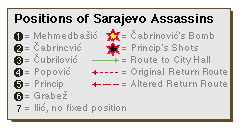
Quay to cheer the imperial couple. Amid the festive crowd mingled seven
young assassins. They took up their assigned positions, all but one along
the river side of the Appel Quay. First in line was Mehmedbasic, to the
west of the Cumurja Bridge. Near him was Cabrinovic. The others were strung
out as far back as the Kaiser Bridge.

The Bomb
The motorcade approached and the crowds began to cheer. As Franz Ferdinand's
car passed Mehmedbasic, he did nothing. The next man in line, Cabrinovic,
had more resolve. He took the bomb from his coat pocket, struck the bomb's
percussion cap against a lamp post, took aim and threw the bomb directly
at Franz Ferdinand.
In the short time it took the bomb to sail through the air, many small
events took place. The car's owner, Count Harrach, hearing the bomb being
struck against the lamp post, thought they had suffered a flat tire. "Bravo.
Now we'll have to stop." The driver, who must have seen the black object
flying, did just the opposite--he stepped on the accelerator. As a result,
the bomb would not land where intended. Franz Ferdinand, also catching
a glimpse of the hurtling package, raised his arm to deflect it away from
Sophie. She sat to his right, and so was between Franz Ferdinand and Cabrinovic.
The bomb glanced off Franz Ferdinand's arm, bounced off the folded car
top and into the street behind them. The explosion injured about a dozen
spectators. The third car was hit with fragments and stalled. Merizzi received
a bad cut to the back of the head. Others in the party received minor cuts.
The first and second cars continued on for a few moments then stopped while
everyone assessed who was injured and who was not.
After the Bomb
Cabrinovic swallowed his cyanide and jumped into the river. The trouble
was, the poison was old--it only made him vomit--and the river was only
a few inches deep. He was quickly seized by the crowd and arrested. The
motorcade continued on to City Hall, passing the other assassins. Either
because they thought Cabrinovic had succeeded or from lack of resolve,
they failed to act. At City Hall, a furious Franz Ferdinand confronted
the Mayor. "Mr. Mayor, one comes here for a visit and is received by bombs!
It is outrageous!" After a pause to calm himself, he regained his composure
and let the Mayor speak. The Mayor, either completely unaware of what had
happened, or personally ill equiped for crises, launched into his prepared
speech. "Your Royal and Imperial Highness!...Our hearts are full of happiness..."
By the end of the Mayor's speech, Franz Ferdinand had regained his
composure and thanked his host for his cordial welcome. Activities at City
Hall were observed as planned.
Changed Plans
Discussions were held as to whether to change the rest of Franz Ferdinand's
schedule. The Archduke did not wish to cancel his visit to the museum and
lunch at the Governor's residence, but wished to alter his plans to include
a visit to Merizzi in the hospital. The same motorcade set out along the
Appel Quay, but neither the Mayor's driver, nor Franz Ferdinand's driver
had been informed of the change in schedule. This would have been Merizzi's
job. The young assassins had counted on succeeding on the first attempt.
With no assurance that Franz Ferdinand would follow his original itinerary,
the remaining assassins took up various other positions along the Appel
Quay. Gavrilo Princip crossed the Appel Quay and strolled down Franz Joseph
Street. He stepped into Moritz Schiller's food store to get a sandwich.
As he emerged, he met a friend who inquired about a mutual friend.
The Wrong Turn
The Mayor's car, followed by Franz Ferdinand's car turned off the Appel
Quay and onto Franz Joseph Street, as originally planned, to travel to
the museum. General Potoirek leaned forward. "What is this? This is the
wrong way! We're supposed to take the Appel Quay!" The driver put on the
brakes and began to back up. Franz Ferdinand's car stopped directly in
front of Schiller's store--five feet away from Princip.
The Shots
Princip was quick to recognize what had happened. He pulled the pistol
from his pocket, took a step towards the car and fired twice. General Potoirek
happened to look directly at Princip as he fired. He thought the gun's
report unusually soft. Both Franz Ferdinand and Sophie were still sitting
upright. Potoirek thought the shots had missed, but given the assult, ordered
the driver to drive directly to the Governor's residence. Princip then
turned the gun on himself, but was mobbed by the crowd. Police had to rescue
Princip from the crowd before they could arrest him. Princip had swallowed
his poison, but it was from the same batch as Cabrinovic's. He was violently
ill, but did not die.
Mortal Wounds
As the car sped across the Lateiner Bridge, a stream of blood shot
from Franz Ferdinand's mouth. He had been shot in the neck. Sophie, seeing
this, exclaimed: "For Heaven's sake! What happened to you?" She sank from
her seat. Potoirek and Harrach thought whe had fainted and were trying
to help her up. Franz Ferdinand, knowing his wife better, suspected the
truth. Sophie had been shot in the abdomen and was bleeding internally.
"Sopherl! Sopherl! " he pleaded. "Sterbe nicht! Bleibe am Leben
für unsere Kinder! " (Sophie dear! Sophie dear! Don't die! Stay
alive for our children!) The cars rushed to the Governor's residence. Sophie
may have died before they arrived. Franz Ferdinand died shortly afterward.
The July Crisis
The murders of Franz Ferdinand and Sophie brought Austro-Serbian tensions
to a head. Serbia had been fomenting trouble for Austria for many years.
For many in Vienna, the double murders provided the 'last straw' for a
get-tough showdown. The trail back to the Black Hand would not be unraveled
for years to come. Vienna felt she could not wait for conclusive proof
and acted based on the mass of circumstantial evidence. As Vienna took
a hard line against Serbia, the other powers in Europe took sides. The
wheels of war gained speed. The stakes far outgrew the squabble between
Austria and Serbia. The Crisis of July turned into world war, just over
thirty days after Franz Ferdinand and his wife Sophie were shot.