|

|
|
|

|
Somalia is a
strategically located country in East Africa steeped in thousands of years of
history. (The ancient Egyptians spoke of the area as the Land of God.)
Situated in the Horn of Africa adjacent to the Arabian Peninsula, Somalia
borders Djibouti to its northwest, Ethiopia to its west, and Kenya to its
southwest. Slightly smaller than Texas, the country has a long coast to its
east (the Indian Ocean) and its north (the Gulf of Aden). A considerable part
of the interior of the country is desert and semi-desert grasslands.
Although divided into numerous warring clans that are currently vying for
power in the divided country, Somalia does not have the same degree of ethnic
diversity as other African states. About 85 percent of the population is
designated as Somali and speak the official language Somali as their native
tongue. There is a small Arab minority in the country as well as non-Somali
African tribal groups, such as the Oromo. Nomadic and semi-nomadic people
dependent upon livestock for their livelihood make up a large portion of the
population. The vast majority of the population is Sunni Muslim, though there
is a small Christian minority there as well.
|
|
|
Source: Hiram A.
Ruiz
|
|
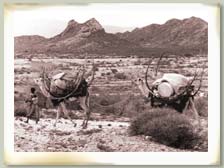
Camel
caravan transporting goods in northern Somalia between Hargeysa and Berbera
|
The modern
history of Somalia history is an intricate and complex mix of traditional
clan politics, colonialism, and Cold War intrigues. Genealogy and clan
politics constitute the heart of the Somali social system, as has been the
case there for centuries. It is the basis of the collective Somali
inclination toward internecine conflict, as well as of the sense Somalis have
of being a distinct national group, two seemingly contradictory impulses.
There are six major branches of the Somali lineage system, four
overwhelmingly pastoral nomadic clan-families (the Dir, Daarood, Isaaq, and
Hawiye, each of which is further subdivided into smaller sub-clan groupings),
and two agricultural ones (the Digil and Rahanwayn). The Dir, Daarood, Isaaq,
and Hawiye together constitute roughly 75 percent of the population. The
Digil and Rahanwayn constitute about 20 percent of the population and are
settled mostly in the riverbeds of southern Somalia. Generally speaking, the
post-independence politics of Somalia have been dominated by Daarood clan,
which includes a number of sub-clans, and an alliance of the Hawiye and the
Isaaq clans, which also include several sub-clans. Clan divisions of the
Somali variety inherently militate against the evolution and endurance of a
stable, centralized state, and as a result institutional instability is
actually woven into the fabric of Somali society.
|

|
|
Source: Library of
Congress country studies
|
|
Main
clans and sub-clans in Somalia
|
 Map of Somali
clan groups
In part because
of its strategic location, Somalia was divided among three European powers
during the colonial period from 1884 to 1960): British Somaliland (north
central); French Somaliland (east and southeast); and Italian Somaliland
(south). Of these the British and Italian areas were the largest and most
important because of their location along the coast. The early 20th
century was marked by strong resistance from northern Somali clans to British
rule. A Sufi holy man, Mahammad Abdille Hasan, dubbed the mad mullah by the
British, led a persistent resistance movement against the British between
1899 and 1920. The fighting devastated the Somali Peninsula and resulted in
the death of an estimated one-third of the population in northern Somalia, as
well as the devastation of its economy. One of the longest and bloodiest
conflicts in the history of sub-Saharan African resistance to European rule,
the uprising was not quelled until 1920 with the death of Hasan, who became a
hero of Somali nationalism. The British finally ended the uprising by
deploying a Royal Air Force squadron recently returned from combat in World
War I, devastating the rebel capital at Taleex in northern Somalia with
aerial bombardment. This conflict spilled over into the southern Italian-held
territories, but it was mostly contained to the north because the supporting
clans hailed from there; thus this early resistance movement against European
rule among the Somalis reflected the significance of clan divisions in the divided
territories of Somaliland.
|

|
|
Somailia
divided between the colonial powers
|
Under
the rule of dictator Benito Mussolini Italian forces marched into Ethiopia
and toppled Emperor Haile Selassie in 1935, and the Italians also seized
British Somaliland, uniting for the first time in forty years all the Somali
clans that had been arbitrarily separated by the Anglo-Italo-Ethiopian
boundaries. The elimination of these artificial boundaries and the
unification of the Somali Peninsula enabled the Italians to set prices,
impose taxes, and issue a common currency for the entire area. Italian
control over the region turned out to be short-lived, however. In March 1941,
the British counterattacked and reoccupied northern Somalia, from which they
launched their campaign to retake the whole region from Italy and restore
Emperor Haile Selassie to his throne in neighboring Ethiopia. The British
then placed southern Somalia and the Ogaden (the region on the border between
Somalia and Ethiopia) under a military administration.
In the aftermath of World War II Somalia was caught amid the conflicting
interests of the victorious allies. Initially, it was decided at the Potsdam
Conference in 1945 not to return southern Somalia to Italian rule, but rather
to form a Council of Ministers representing Britain, France, the USSR, and
the US to decide the fate of the colony. No agreement among the four could be
reached, however, and the question of the status of Somalia was passed to the
United Nations to decide. In November 1949, the General Assembly of the UN
voted to make southern Somalia a trust territory to be placed under Italian
control for ten years, following which it would become independent. The
General Assembly stipulated that under no circumstance should Italian rule
over the colony extend beyond 1960. Northern Somalia would remain under
British control indefinitely. The General Assembly seems to have been
persuaded by the argument that Italy, because of its experience and economic
interests, was best suited to administer southern Somalia. This decision
clearly went against the increasing demands of educated Somalis, many of whom
were organized as of 1943 into the Somali Youth League (SYL), that all areas
populated by Somali-speaking people be united in an independent state.
As the ten-year period of UN-Italian rule in the south neared an end, moves
were made for a transition to independence. Meanwhile, the British acquiesced
to the force of Somali nationalist public opinion and agreed to terminate its
rule of northern Somaliland in 1960 in time for the protectorate to merge
with the trust territory on the independence date already fixed by the UN
commission. Accordingly, British Somaliland received its independence in late
June and united with the trust territory to establish the Somali Republic on
July 1, 1960. (The French-controlled territory, by the way, became the independent
state of Djibouti in 1977).
The legacy of colonial rule was very important in Somalia. Although unified
as a single nation at independence, the south and the north were, from an
institutional perspective, two separate countries. Italy and Britain had left
the two with separate administrative, legal, and education systems in which
affairs were conducted according to different procedures and in different
languages. Police, taxes, and the exchange rates of their respective
currencies also differed. Their educated elites had divergent interests, and
economic contacts between the two regions were virtually nonexistent. Many
southerners believed that, because of experience gained under the UN-Italian
trusteeship, theirs was the better prepared of the two regions for
self-government. Northern political, administrative, and commercial elites,
meanwhile, were reluctant to recognize that they now had to deal with
Mogadishu. Indeed, Northern misgivings about being too tightly harnessed to
the south were demonstrated by the voting pattern in the June 1961 referendum
on the constitution, which was in effect the first national election in
Somalia Although the draft was overwhelmingly approved in the south, it was
supported by less than 50 percent of the northern electorate. The newly
independent country clearly had some major regional divisions to overcome.
Another significant issue facing the newly independent state of Somalia was
the existence of large Somali populations outside its borders, in neighboring
Kenya, Ethiopia, and Djibouti. As we have seen, this is one of the common
legacies of colonialism with the imposition of artificial borders in Africa
and throughout much of the formerly colonized world. Between 1960 and 1964
Somali bands carried out raids across the Kenyan border, and in 1964 a
small-scale war erupted between Ethiopia and Somalia over its disputed border
regions. Hostilities ended through the mediation of Sudan, acting under the
auspices of the Organization of African Unity (OAU), with the disputed Somali-inhabited
territory remaining under Ethiopian control. Meanwhile, Ethiopia and Kenya
concluded a mutual defense pact in 1964 in response to what both countries
perceived as a continuing threat from Somalia. The pact was renewed in 1980
and again in 1987. Most OAU members feared that if Somalia were successful in
detaching the Somali-populated portions of Kenya and Ethiopia, the example
might inspire their own restive minorities divided by frontiers imposed
during the colonial period. Pan-Somalism remains an important domestic
political issue within the country, although two decades plus of clan warfare
there seems to have diminished the importance of territorial disputes with
neighboring states.
|
|
|
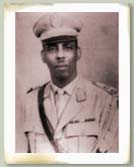
Muhammad
Siad Barre, military dictator of Somalia, 1969-91 in the 1970s
|
|
|
|
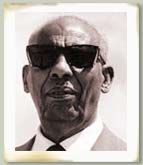
Muhammad
Siad Barre (1919-1995) in the late 1980s
|
The current
political troubles for Somalia began in October 1969, with a military coup
that overthrew its short-lived democracy. In the wake of voting
irregularities and the assassination of President Rashid Shermaarke, the
military moved to take power in a bloodless coup under the leadership of
Major General Muhammad Siad Barre. The new governing body, the Supreme
Revolutionary Council (SRC), arrested and detained leading members of the
democratic government, including Prime Minister Muhammad Ibrahim Igaal,
though they were not executed. The SRC banned political parties, abolished
the National Assembly, and suspended the constitution. The new goals of the
new regime included an end to tribalism, nepotism, corruption, and misrule
and the unification of all Somali people under a single state. The country
was renamed the Somali Democratic Republic.
The SRC retroactively defined the military coup as a Marxist revolution and
reorganized the political and legal institutions, formulating a guiding ideology
based on the Quran as well as on Marx. (Barre even published his own
equivalent of the little Red Book by Mao Zedong in China, calling it the Blue-and-white
book). The SRC took its toughest political stance in the campaign to break
down the solidarity and political power of the six main clans in Somalia. Tribalism
was condemned as a form of class rule and as the most serious impediment to
national unity. Clan leaders, whom the previous government had paid a
stipend, were replaced by SRC-appointed local dignitaries known as peacekeepers.
Siad Barre often contrasted the benefits of socialism to the evils he
associated with tribalism. The SRC also began a policy of settling the nomadic
peoples of Somalia into fishing and farming communities as a way of breaking
clan identities. However, despite government efforts to eliminate it, clan
consciousness persisted. Likewise, the attempts by the SRC to improve the
status of Somali women were unpopular in this traditional Muslim society,
despite the insistence by Barre that such reforms were consistent with
Islamic principles.
In the mid-1970s Somalia received considerable military aid from the USSR,
building up one of the largest military forces in sub-Saharan Africa, while
allowing the Soviets to establish a naval base in the port city of Berbera.
In 1977 Somali troops invaded the disputed border region with Ethiopia,
sparking the Ogaden War (1977-78). During the conflict, the USSR switched
sides and began supporting Ethiopia, where leftist military officers had
overthrown the government of Emperor Heile Selassie in 1974, with military
supplies. In response, Barre expelled Soviet advisors and ousted them from
the naval base in Berbera in late 1977. Soviet aid to Ethiopia turned the
tide in their favor, and the subsequent loss by Somalia in the war led to
increasing political pressure and repression at home. Barre began to clamp
down on any form of perceived political dissidence and to collectively punish
entire clans whose members may have engaged in organized political
resistance. The war also led Somalia to shift to a pro-Western stance in the
Cold War, with the US replacing the Soviet Union as the main supplier of
weapons and economic aid to the country, as well as becoming the main user of
the naval base at Berbera.
|
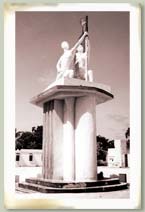
Statue of socialist workers, Mogadishu,
erected in the 1970s (Source: Hiram A. Ruiz)
|
|
|
Thus
by 1980 Somalia and Ethiopia had completed one of the most bizarre
turnarounds in Cold War politics, with the latter, a staunch US ally from the
end of World War II to 1974, now firmly in the Soviet camp, and the former,
still under the leadership of Siad Barre, now firmly in the US camp. In 1986
the US and Somalia held joint military exercises in the Indian Ocean, while
that same year Amnesty International criticized the Somali regime as among
the worst abusers of human rights in the world. In fact, wholesale human
rights violations documented by Amnesty International, and subsequently by
Africa Watch, prompted the United States Congress by 1987 to make deep cuts
in military aid to Somalia.
Meanwhile, economically between 1983 and 1987 the IMF and World Bank pressured
the Somali regime to liberalize its economy through a series of market reforms.
To meet IMF standards for Structural Adjustment loans, the government
terminated its policy of granting guaranteed employment to everyone with a
secondary school education. In general, international lending agencies active
in Somalia in the 1980s encouraged the elimination of civil service jobs (a
common IMF/WB reformist policy). As of 1985, although 5,000 civil servants
had been dismissed, Agency of International Development (AID) officials felt
that 80 percent of the civil service was still redundant. At the same time,
privatization of banking and other state-dominated sectors of the economy was
encouraged, as was devaluation of the currency, the Somali shilling. As
elsewhere in Africa and the developing world, the immediate, short-term
results of these reforms were disastrous:
- Unemployment soared, leading to a
growing sector of disgruntled, educated former civil service employees;
- Manufacturing declined 0.5 percent
per year from 1980 to 1987;
- Exports decreased by 16.3 percent
per annum from 1979 to 1986;
- A negligible 0.8 percent rise in
Gross Domestic Product (GDP) per annum from 1979 to 1986 did not even
keep up with population growth.
Estimates by the
World Bank itself show that between 1980 and 1989 real Gross National Product
(GNP)--the measure of all wealth produced in a country--per person had
declined in Somalia at a rate of 1.7 percent per year. These economic
problems further compounded the political tensions that eventually erupted in
civil war by the late 1980s.
By 1986, faced with shrinking popularity and a growing, clan-based armed
resistance, Siad Barre resorted to the one thing he had so vehemently
preached against earlier in his reign--clan warfare. He unleashed a reign of
terror against the Majeerteen, the Hawiye, and the Isaaq clans, relying on
thugs dubbed the Red Berets, a dreaded elite unit recruited from among the Mareehaan
clans to which Barre himself belonged. One of the worst atrocities of the
clan conflict of the late 1980s was directed at the Isaaq clan, which in 1988
had initiated an armed movement under the auspices of the Somali National
Movement (SNM) in the north to unseat Barre. The SNM captured two northern
cities, but government forces loyal to Barre responded by bombarding the
cities heavily in June 1988, forcing the SNM to withdraw and causing more
than 300,000 Isaaq to flee to Ethiopia. After re-imposing its control in the
north, the Somali regime conducted savage reprisals against the Isaaq. In a
particularly nefarious form of warfare, they destroyed or poisoned water
wells, burned the grazing grounds of Isaaq pastoralists, and systematically
raped Isaaq women. An estimated 5,000 Isaaq were killed in the conflict by
the end of 1988, about 1,000 of whom, including women and children, were
alleged to have been bayoneted to death.
Barre calculated that dealing harshly with resistance would nip it in the bud;
he was wrong, however, as resistance continued and even escalated. In 1989,
his hold on power increasingly tenuous, Siad Barre ordered the Red Berets to
massacre civilians. Torture and murder became commonplace in Mogadishu. On
July 9, 1989, an Italian-born Roman Catholic bishop, Salvatore Colombo, was
gunned down in his church in Mogadishu by an unknown assassin. The order to
murder the bishop, an outspoken critic of the regime, was widely believed to
have originated in the presidential palace. On the heels of the murder came
the infamous July 14 massacre, when the Red Berets slaughtered 450 Muslims
and injured thousands more who were demonstrating against the arrest of
fourteen leading Muslim clerics. The following day, July 15, forty-seven
people, mainly from the Isaaq clan, were summarily executed on a beach near
Mogadishu. The July massacres prompted a shift in US policy, as the
administration of President George Bush Sr. decided to distance itself from
Barre. Much of his political career had rested on one of the two major Cold
War superpowers, and as the Cold War receded in importance by the late 1980s,
Barre was suddenly no longer important to either side.
With US support cut off and domestic pressures against him increasing, it was
only a matter of time before the brutal regime led by Barre came to end. In
late January 1991, the Hawiye clan-based United Somali Congress (USC) entered
Mogadishu led by General Muhammad Farah Hassan Aideed, forcing Barre and his
remaining troops to flee the capital. A period of looting and chaos ensued in
the capital, and hundreds of thousands of Somalis were internally displaced
throughout the country as they relocated to areas that their clans controlled
(including Siad Barre himself, who fled to the safety of southern Somalia controlled
by his own Mareehaan clan). In place of the centralized government, armed
clan militias emerged to fight one another for political power: the
Isaaq-affiliated SNM, which declared an independent Somaliland Republic in
the north in accordance with the borders of the former British colony there;
the Majeerteen-based Somali Salvation Democratic Front (SSDF); the
Ogaden-supported Somali Patriotic Movement (SPM); the Gadabursi-based Somali
Democratic Alliance (SDA); and the Rahanwayn-based Somali Democratic Movement
(SDM). By 1992 the centralized state constructed on the Somali Peninsula had
all but disintegrated into its constituent lineages and clans, whose
internecine wars were drenching the country in bloodshed. A drought in the
country in the early 1990s compounded problems, leading to a potential
humanitarian disaster.
|
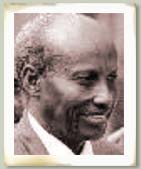
Somali warlord General Muhammad Farah
Hassan Aideed (1934-1996)
|
|
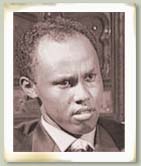
Husswin Aideed (b. 1962), son and
successor to Muhammad Farah Hassan Aideed
|
In 1992, after
more than 50,000 people were killed in the war and more than 300,000 people
starved to death, the United Nations ecided to intervene. The UN peacekeeping
force, led by the US Marines, supervised the distribution of food and other
humanitarian aid, averting an even worse humanitarian problem, and tried to
organize a provisional government. In March 1993, a ceasefire was proclaimed
between rival warlords in southern Somalia after tedious negotiating by UN
officials. The UN peacekeepers took control of southern Somalia, but the
militias were not disarmed. In June Aideed, leader of the Hawiye clan-based
USC that had ousted Barre in January 1991, broke the ceasefire and attacked
the UN peacekeepers. Clashes between the USC militia and the UN peacekeepers
intensified, making it impossible for the UN mission to operate in Somalia.
Thus, the US and the UN made the removal of Aideed a primary goal of the
mission, which had not been the case at the outset of the intervention.
Aideed, however, was backed by a well-armed militia group and resisted US and
UN calls that he turn himself in, setting up one of the most gruesome
engagements in recent US military history: the street battle in Mogadishu in
October 1993, in which 18 US Marines and countless Somali civilians were
killed. Days later, after major US media outlets aired footage of celebrating
Somalis dragging the corpse of an American soldier through the streets of
Mogadishu, US President Bill Clinton decided to abruptly end the mission and
withdraw US troops from the country. While the US left in disgrace, Aideed
remained in charge of his clan-based militia (the USC) until his death in
1996, when he was replaced by his son Hussein Aideed.
In March 1995,
the UN humanitarian mission in Somalia was aborted amid continued fighting
and all UN personnel left the country. With the departure of UN officials,
Somalia descended back into chaos and civil war (perhaps best described as
internecine clan warfare), which unfortunately has become the norm in Somalia
over the past 20 plus years. In December 1997 Somali clan leaders met in
Cairo and agreed on a plan to select a new unified national government. The
summit was delayed for two years, however, as clan leaders failed to secure a
ceasefire between the various warlords. In 1998 three northeastern areas
seceded from Somalia to form the independent republic of Puntland. Finally,
in May 2000, a national reconciliation summit was held in Djibouti. Over the
course of four months, Somali clan leaders, warlords, and politicians
discussed the future of Somalia. In August the Somali delegates elected a
transitional assembly representative of the various clans and elected
Abdulkassim Salat Hassan as interim president of Transitional National Assembly
(TNA). However, this summit did not bring all the Somali factions to the
discussion table as Somaliland and Puntland boycotted the summit. Initially,
promises made in Djibouti were respected, and the TNA established control
over southern Somalia; however, factional fighting erupted once again and by
May 2001 the TNA lost control over most of the country. Today Somalia is
still engulfed in chaos and anarchy, and warlords remain the real power in
the country. The TNA controls Mogadishu to some degree; however, the rest of
the country is divided into various militia-controlled areas.
The
legacy of clan-based conflict, colonialism, and the Cold War have left
Somalia a very divided and torn nation, despite the fact that it began as an
independent state with a potentially promising future over fifty years ago.
The economy remains plagued by external debt, estimated in 2000 at $2.6
billion. The suffering of the population is immeasurable, but a telling
statistic is that life expectancy in Somalia is ~47 years, comparable to that
of Afghanistan as one of the lowest in the world. Finally, to make matters
worse, Somalia has been one of the countries pegged by US leaders as a
possible haven for Al-Qaeda and ISIS terrorists wanting to take advantage of
the chaotic situation in the country to set up camps there. The home-grown Somali
terrorist group Al-Shabab, is allied with Al-Qaeda. According to a 2019 Human
Rights Watch report:
Fighting, insecurity
and lack of state protection, and recurring humanitarian crisis had a
devastating impact on Somali civilians in 2018. The number of internally
displaced people, many living unassisted and at risk of serious abuse, reached
an estimated 2.7 million. The Islamist armed group Al-Shabab subjected people
living under its control to harsh treatment, forced recruitment, and carried
out deadly attacks targeting civilians.
Somalia,
in short, is a country with a difficult and divided past and a very uncertain
future.
|