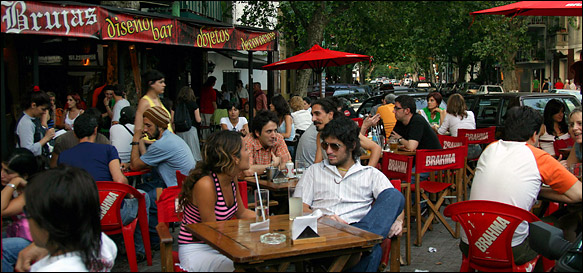
Tomas Munita for The New York Times
A busy
restaurant in
Buenos Aires reflects an economic recovery in which exports have
zoomed, the currency is stable, investors are gradually returning and
unemployment has eased from record highs.Argentina's Crisis, IMF's Fingerprints
by Mark Weisbrot
Washington Post
December 25, 2001
As Argentina's government was resigning in the
face of full-scale riots and protests from every sector of society, a
BBC-TV reporter
asked me whether this economic and political meltdown
would
change the way people viewed the International Monetary Fund. I wanted
to
say yes,
but I had to tell him: "It really depends on how the media
reports
these events."
So far it looks as if the IMF is getting off easy, once
again.
The Fund and the World Bank -- the world's two most powerful financial
institutions -- learned an important lesson from their
brief
spate of bad publicity during the Asian economic crisis a few years
ago.
They
have become masters of the art of "spinning" the news.
Argentina's implosion has the IMF's fingerprints all
over it. The first and overwhelmingly most important cause of the
country's economic
troubles was the government's decision to maintain its
fixed
rate of exchange: one peso for one U.S. dollar. Adopted in 1991, this
policy
worked for awhile. But over the past few years, the U.S.
dollar
has been overvalued. This made the Argentine peso overvalued as well.
Contrary to popular belief, a "strong" currency is not
like
a strong body. It is very easy to have too much of a good thing. An
overvalued
currency makes a country's exports too expensive and its
imports
artificially cheap. Just look at the United States, where our "strong"
dollar has brought us a record $400 billion trade deficit.
But it gets catastrophically worse for a country that
has committed itself -- as Argentina has -- to a fixed exchange rate.
When investors
start to believe that the peso is going to fall, they
demand
ever higher interest rates. These exorbitant interest rates are
crippling
to
the economy. This is the main reason Argentina has not
been
able to recover from its 4-year-old recession.
To maintain an overvalued currency, a country needs
large reserves of dollars: The government has to guarantee that
everyone who wants
to
exchange a peso for a dollar can get one. The IMF's role
here
was crucial: It arranged massive amounts of loans -- including $40
billion
a year ago -- to support the Argentine peso.
This was the IMF's second fatal error. To appreciate
its severity,
imagine the United States borrowing $1.4 trillion -- 70 percent of our
federal budget -- just to prop up our overvalued dollar.
It
didn't take long for Argentina to pile up a foreign debt that was
literally impossible to pay back.
As if all that weren't enough, the Fund made its loans
conditional
on a "zero-deficit" policy for the Argentine government. But it is
neither
necessary nor desirable for a government to balance its
budget
during a recession, when tax revenues typically fall and social
spending
rises.
The "zero-deficit" target may make little economic
sense, but it has great public relations value. By focusing on
government spending, the
IMF has managed to convince most of the press that
Argentina's "profligate" spending habits are the source of its
troubles. But
Argentina has run only modest budget deficits, much
smaller than
our own deficits during recessions.
The IMF now claims that it was against the fixed
exchange rate, and the massive loans to support it, all along. Fund
officials say they
went
along with these policies to please the Argentine
government. So now Argentina tells the U.S. government what to do! This
is not a very
credible story, but of course verifying who made what
decision
is a little like tracking the chain of command at al Qaeda. IMF board
meetings, consultations with government ministers and
other
deliberations are secret.
But they do have a track record. In 1998 the Fund
supported overvalued currencies in Russia and Brazil, with massive
loans and sky-high
interest rates. In both cases the currencies collapsed
anyway,
and both countries were better off for the devaluation: Russia's growth
in
2000
was its highest in two decades.
Argentina will undoubtedly recover too, after it
devalues its currency and defaults on its unpayable foreign debt. But
the people will
need a
government that is willing to break with the IMF and
pursue policies
that put their own national interests first.
Washington has other ideas. "It's important for
Argentina to continue to work through the International Monetary Fund
on sound policies,"
said White House spokesman Ari Fleischer on Friday. For
the
IMF, failure is impossible.
|
Tomas Munita for The New York Times
A busy
restaurant in
Buenos Aires reflects an economic recovery in which exports have
zoomed, the currency is stable, investors are gradually returning and
unemployment has eased from record highs. |
 UENOS
AIRES - When the Argentine economy collapsed in December 2001,
doomsday predictions abounded. Unless it adopted orthodox economic
policies and quickly cut a deal with its foreign creditors,
hyperinflation would surely follow, the peso would become worthless,
investment and foreign reserves would vanish and any prospect of growth
would be strangled.
But three years after Argentina declared a record debt default of more than $100 billion, the largest in history, the apocalypse has not arrived. Instead, the economy has grown by 8 percent for two consecutive years, exports have zoomed, the currency is stable, investors are gradually returning and unemployment has eased from record highs - all without a debt settlement or the standard measures required by the International Monetary Fund for its approval.
Argentina's recovery has been undeniable, and it has been achieved at least in part by ignoring and even defying economic and political orthodoxy. Rather than moving to immediately satisfy bondholders, private banks and the I.M.F., as other developing countries have done in less severe crises, the Peronist-led government chose to stimulate internal consumption first and told creditors to get in line with everyone else.
"This is a remarkable historical event, one that challenges 25 years of failed policies," said Mark Weisbrot, an economist at the Center for Economic and Policy Research, a liberal research group in Washington. "While other countries are just limping along, Argentina is experiencing very healthy growth with no sign that it is unsustainable, and they've done it without having to make any concessions to get foreign capital inflows."
The consequences of that decision can be seen in government statistics and in stores, where consumers once again were spending robustly before Christmas. More than two million jobs have been created since the depths of the crisis early in 2002, and according to official figures, inflation-adjusted income has also bounced back, returning almost to the level of the late 1990's. That is when the crisis emerged, as Argentina sought to tighten its belt according to I.M.F. prescriptions, only to collapse into the worst depression in its history, which also set off a political crisis.
Some of the new jobs are from a low-paying government make-work program, but nearly half are in the private sector. As a result, unemployment has declined from more than 20 percent to about 13 percent, and the number of Argentines living below the poverty line has fallen by nearly 10 points from the record high of 53.4 percent early in 2002.
"Things are by no means back to normal, but we've got the feeling we're back on the right track," said Mario Alberto Ortiz, a refrigeration repairman. "For the first time since things fell apart, I can actually afford to spend a little money."
Traditional free-market economists remain skeptical of the government's approach. While acknowledging there has been a recovery, they attribute it mainly to external factors rather than the policies of President Néstor Kirchner, who has been in office since May 2003. Increasingly, they also maintain that the comeback is beginning to lose steam.
"We've been lucky," said Juan Luis Bour, chief economist at the Latin American Foundation for Economic Research here. "We've had high prices for commodities and low interest rates. But if we want to grow in 2005, we're going to have to settle the debt question and have foreign capital come in."
The I.M.F., which Argentine officials blame
for inducing the crisis in the first place, argues that the current
government is acting at least in part as the I.M.F. has always
recommended. It has limited spending and moved to increase revenues, a
classic prescription when an economy is ailing, and has built up a
surplus twice the size of what the fund had asked before negotiations
were put on hold several months ago.
"The return to these encouraging numbers has been helped a lot by a fiscal discipline that is almost unprecedented by Argentine standards," said John Dodsworth, the senior I.M.F. representative here. "We've had a primary surplus which has increased steadily over these past few years at both the central and provincial levels, and that has been the main anchor on the economic side."
But some of that record budget surplus has come from a pair of levies on exports and financial transactions that orthodox economists at the I.M.F. and elsewhere want to see repealed. About a third of government revenues are now raised by those taxes, which have surged.
"The I.M.F. wants these taxes to be eliminated, but on the other hand they also want Argentina to improve its offer to creditors and also pay back the fund so it can reduce its own exposure here," said Alan Cibils, an Argentine economist associated with the independent Interdisciplinary Center for the Study of Public Policy here. "In other words, they are saying, 'You have to pay out more and take in less,' which is a sure prescription for another crisis."
Because of the absence of a debt accord and a stalemate over utility tariffs, some investors, mainly European, continue to shun Argentina, citing what they call the lack of "judicial security." But others, mainly Latin Americans used to operating in unstable environments or themselves survivors of similar crises, have increased their presence here amid expanding opportunities.
"These are slogans that people repeat without thinking, as if they were parrots," Roberto Lavagna, the minister of the economy, said when asked about the predictions that investment would disappear. "In 2001 and the beginning of 2002, all kinds of contracts were destroyed," he said. "So why are they investing? Because today clearly they can get a very good rate of return."
The Brazilian oil company Petrobras bought a stake in a leading energy company. Another Brazilian company, AmBev, has acquired a large interest in Quilmes, Argentina's leading beer brand, and a Mexican company has bought up control of a leading bread and cake maker.
Asian countries, with China and South Korea in the lead, have begun to move in. During a state visit last month, the Chinese president, Hu Jintao, announced that his country plans to invest $20 billion in Argentina over the next decade.
But the bulk of the new investment comes from Argentines who are beginning to spend their money at home, either bringing their savings back from abroad or from under their mattresses. For the first time in three years, more money is coming into the country than is leaving it.
That has given Mr. Kirchner the luxury of taking a hard line with the monetary fund and with foreign creditors clamoring for repayment.
"The thing is that Argentina has a current account surplus, so they don't really need so much foreign investment," said Claudio Loser, an Argentine economist and the former Western Hemisphere director for the I.M.F. "Domestic investment is taking place because there are opportunities in agriculture, oil and gas."
Just this week, the government announced that reserves of foreign currency have climbed back to $19.5 billion, their highest level since the crash and more than double the low recorded in the middle of 2002, a year with a net outflow of $12.7 billion.
"The peak of investment in the 1990's was 19.9 percent" of gross domestic product annually "and today it is at 19.1 percent, having risen from a low of 10 percent," Mr. Lavagna said. The Kirchner administration continues to seek an accord on the $167 billion in debt that is still outstanding, and plans to make what it calls its final offer early next month. But the turnabout here has inspired such a sense of confidence that the government is not only talking about cutting its last ties to the I.M.F. but also insisting that any payback to bondholders be linked to Argentina's continued good economic health.
"It's very simple," Mr. Lavagna said. "Nobody can collect from a
country that is not growing."