1 of 9
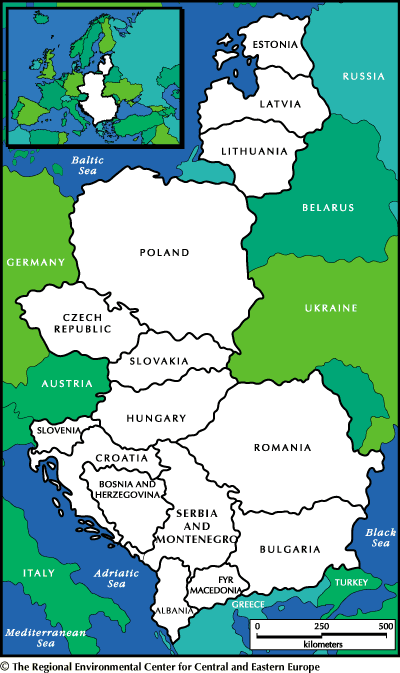
Eastern Europe is a very diverse region, consisting of a number of
different
countries. The Eastern half of Germany defines one border, with
Poland,
the Czech Republic, Slovakia, Hungary, Romania, the former Yugoslavia
(Slovenia,
Croatia, Bosnia and Herzegovina, Macedonia, and Serbia and Montenegro),
Albania,
Bulgaria, and now the former Soviet Republics of Estonia, Latvia,
Lithuania,
Belarus, and Ukraine comprising the area commonly known as "Eastern
Europe." The region historically has been lumped together because
of its domination by one of three vast pre World War I Empires, the
Russian, Austro-Hungarian, and Ottoman (Turkish) Empires. Also,
in the inter war period (1919-1939), the newly independent countries of
Eastern Europe followed a similar pattern, with weak parliamentary
democracies giving way to fascist dictatorships during
the Great Depression of the 1930s and subsequently to German occupation
during
World War II. Most of these countries, moreover, shared the
common
fate of Soviet occupation during the Cold War period, Red Army troops
withdrawing
only in the late 1980s. With the end of Soviet hegemony and the
Cold
War, according to British historian Geoffrey Swain, we are likely to
witness
at long last the individual development of the various states of
Eastern
Europe, and soon it will be much more difficult to describe "Eastern
Europe"
in terms of a single, unified region.

